Good habits to start, and how to make them stick
Good habits to start are small, daily and easy to check off: a 20-minute walk, reading a few pages, drinking water, tidying for ten minutes, or writing one line in a journal. Pick one to three, not ten. A habit you do every day beats a better one you do twice.
Habit · tiny version for a bad day
Body
- Walk 20 minutes
Walk to the end of the street - Drink 8 glasses of water
One glass with breakfast - Stretch in the morning
Touch your toes once - In bed by 11
Phone on the charger at 11
Mind
- Read 20 pages
Read one page - Meditate 10 minutes
Three slow breaths - Journal
Write one line about today - No phone for the first hour
No phone until after breakfast
Home and money
- Tidy for 10 minutes
Clear one surface - Cook at home
Make tomorrow’s lunch - Log what you spend
Check one purchase - Make your bed
Straighten the duvet
Learning and people
- Practise a language
Learn one word - Practise an instrument
Play one scale - Message a friend
Reply to one message - Write down one thing you’re grateful for
Think of one thing
What makes a habit worth starting
A good habit is one you can do on your worst day, not your best. Big goals like “get fit” or “read more” aren’t habits yet. “Walk after lunch” and “read before bed” are, because each one has a clear action and a clear moment.
It also needs a yes-or-no answer. At the end of the day you should know whether you did it, without measuring or debating. That is what makes it easy to track and hard to quietly drop.
How many habits should you start at once?
Fewer than you think: one to three. Every new habit competes for the same attention and willpower, and starting five at once usually ends with all five gone by the third week.
Add the next habit when the first ones run without effort. For most people that takes weeks, not days: in a well-known study of habit formation, the average was about 66 days.
How to start a new habit
Pick one habit from the list.
Choose the one you’d be most glad to have done every day this year, not the most impressive one.Decide when and where.
Attach it to something you already do: after coffee, after brushing your teeth, on the walk home.Set the tiny version.
Decide now what counts on a bad day. Doing the tiny version still keeps the habit alive.Check it off every day.
Seeing a streak grow is a small reward on its own. When you miss a day, make sure the next one counts.
Good daily habits for adults with a busy schedule
If your days are full, pick habits that take under ten minutes and fit around things that already happen: water with every meal, a short walk after lunch, five minutes of tidying before bed, one page of a book on the commute.
Mornings work for habits you want done before the day takes over. Evenings suit winding-down habits like reading, journaling or getting to bed on time.
What to do when you miss a day
You will miss days; everyone does. One miss barely matters. Two in a row is how habits quietly end, so the rule is to never miss twice: when you slip, the next day is the restart, not next Monday.
In the app
Start with three habits in Once
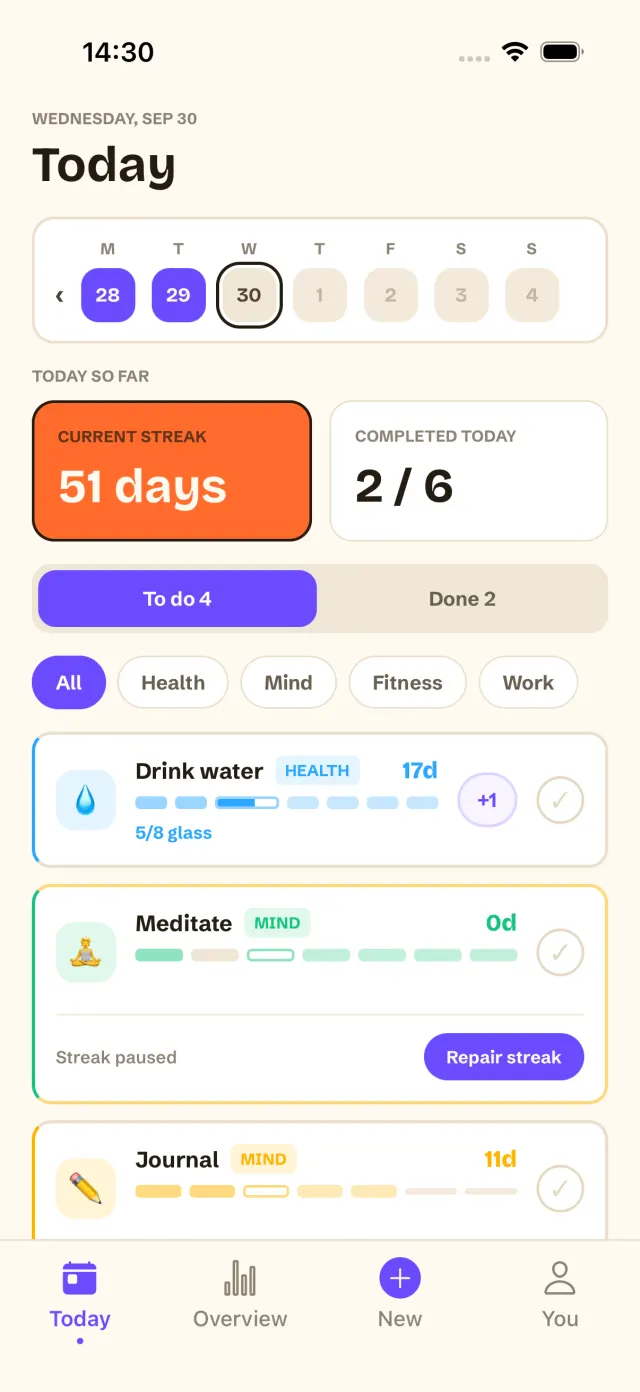
Once is a habit tracker for iPhone that’s free for up to 3 habits, which is the right number to start with. Each habit gets an icon, the days it repeats on and a reminder at any time. Check it off with one tap.
Habits you do several times a day, like glasses of water, fill up one tap at a time. Miss a day and a repair day keeps the streak going. There’s no account: your habits stay on your iPhone.
Download on the App StoreQuestions
What are good habits to start?
Small daily ones with a clear yes or no: walking 20 minutes, reading a few pages, drinking water, tidying for 10 minutes, journaling one line, or going to bed at a set time.
How many habits should I start at once?
One to three. Starting more at once usually means none of them stick. Add another habit once the first ones run without effort.
What is the easiest habit to start?
One that takes under two minutes and attaches to something you already do, such as a glass of water with breakfast or one page of a book before bed.
How long does it take to form a new habit?
In a well-known study of habit formation, it took 66 days on average for a daily habit to feel automatic, with a range from 18 to 254 days.
Keep reading