How to stay consistent with habits when motivation fades
To stay consistent, make the habit small enough to do on your worst day, tie it to something you already do, and decide in advance what happens when you miss. Consistency isn’t never missing; it’s coming back quickly. Most habits take around two months to feel automatic, so judge progress in weeks, not days.
66 DOTS = THE 66-DAY AVERAGE
Forming. Some habits were automatic by now, but the average took 66 days: about 45 more to go.
Why staying consistent is hard
Motivation is a feeling, and feelings come and go. A plan that only works when you feel like it will stop working the first week you don’t. That isn’t a character flaw; it’s what happens to almost everyone who starts with a big goal and a burst of energy.
People who stay consistent usually aren’t more disciplined. They have set things up so the habit needs less discipline: it’s small, it happens at the same moment every day, and a bad day doesn’t end it.
How to be consistent when you don’t feel like it
Have a minimum version of the habit that takes almost no effort: one push-up, one paragraph, one minute of stretching. On a low day, do the minimum and count it. The point is to keep the daily slot alive, not to hit a target.
Keep the cue the same even when the habit shrinks. Doing something at the same time and place every day is what eventually makes it automatic.
How to stay consistent with a habit
Start smaller than feels useful.
Two minutes, one page, one glass of water. A habit you can do on a bad day is a habit you’ll still be doing next month.Give it a fixed cue.
Attach it to something that already happens every day: after your first coffee, after brushing your teeth, when you sit down at your desk.Decide what a miss means before it happens.
Plan to never miss twice. One missed day is normal; the next day is the one that counts.Make progress visible.
A streak or a grid of done days turns effort you can’t see into something you can, and don’t want to break.Review it once a week.
Look at which days slip. If it’s always Thursdays, change Thursday rather than blaming your willpower.
How to turn a goal into a daily habit
A goal is an outcome; a habit is what you do every day to get there. “Read more” is a goal. “Read ten pages after dinner” is a habit you can check off.
Pick the smallest daily action that moves you toward the goal, give it a time, and track that action rather than the outcome. The outcome takes care of itself when the action happens most days.
The 66-day habit: how long it really takes
The often-repeated “21 days to form a habit” isn’t what the research found. In a 2009 study at University College London, volunteers picked a new daily habit and reported how automatic it felt. On average it took 66 days to reach a plateau, and the range was wide: from 18 days to 254.
So expect roughly two months, longer for harder habits, and don’t read a rough week three as failure. The same study found that missing a single day didn’t meaningfully slow things down.
In the app
How Once helps you stay consistent
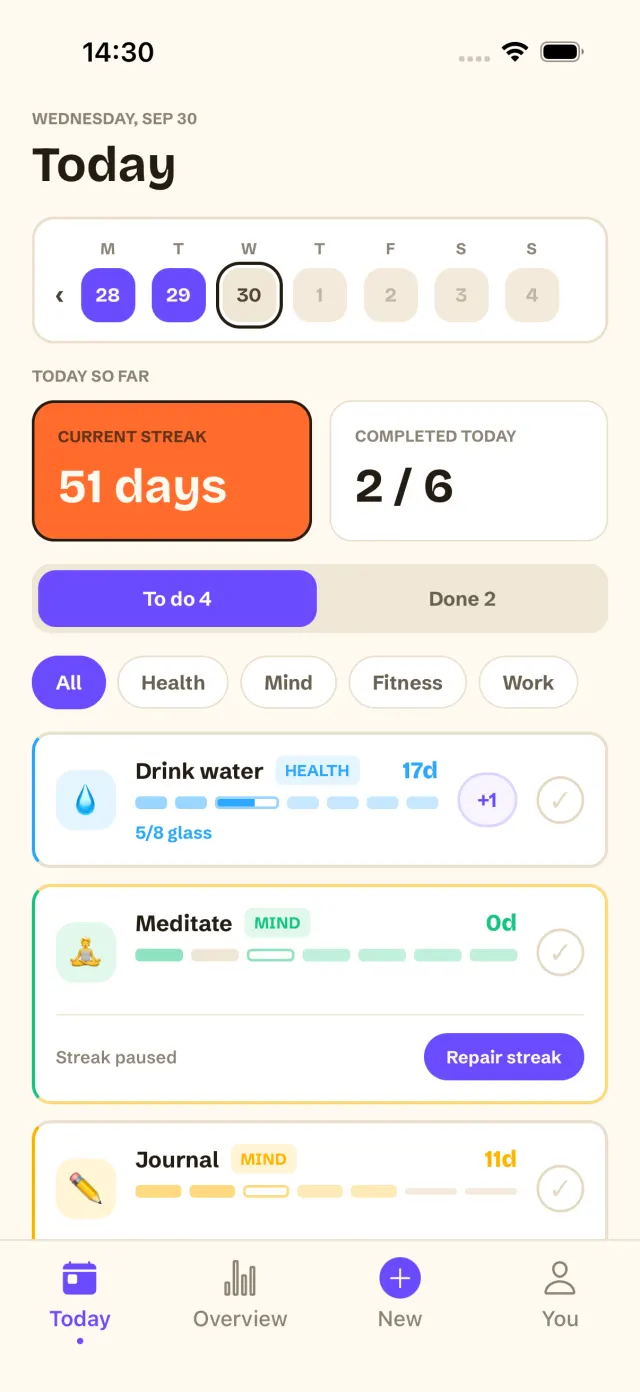
Once is a habit tracker for iPhone that keeps each habit to one tap a day. Give every habit its own reminder time, and when a habit keeps slipping on a particular weekday, Today warns you with an at-risk banner, such as “missed 3 of the last 4 Thursdays”, so a weak day doesn’t catch you by surprise.
New habits can have a streak goal of 7, 14, 30, 66 or 100 days, all free. When you do miss, a repair day keeps the streak going. Once is free for 3 habits.
Download on the App StoreQuestions
How long does it take to become consistent with a habit?
In a 2009 study of habit formation, a new daily habit took 66 days on average to feel automatic, with a range from 18 to 254 days depending on the person and the habit.
What is the 66-day rule?
It comes from that same study: on average, a new daily habit took 66 days to become automatic. It is an average, not a deadline, and many habits take longer.
How do I stay consistent when I lose motivation?
Shrink the habit to a version you can do with no motivation at all, keep the same cue every day, and never miss two days in a row.
Is it better to be consistent or intense?
For building a habit, consistent. A small action done most days is what makes a routine automatic; occasional big efforts don’t.
Keep reading